Monday, May 18, 2020

More Photomontage and Herbert Matter


Herbert Matter did not invent the photomontage, but "he certainly owned it as a means of expression" (Lances 2014).


Fig. 1: Matter 1943. [light drawing] 

Born in Switzerland, Matter originally was a student of painting.  Evolving into a freelance photographer all the way to filmmaker, graphic designer, and professor.  One of his international contributions was his work with photomontage.  

Matter understood photography as a tool for abstraction (Lances 2014).  

"The gesture, the action, the mark, are all there, just made through manipulated mechanical means. Are the resulting images more rigid and geometric in some ways than the pure distillation of action and performance in paintings by artists such as his friends Jackson Pollock, Franz Kline, and Willem de Kooning?  Yes, but not in a way that makes them any less liberating and revolutionary" (Landes 2014).


I like the powerful way he uses light in his images.  My tools and methodology are different but the influence is there.  

This isolation time of COVID-19 has been crazy and a trying.  School, working from home, and 'homeschooling' kids, including 2 teenagers and 2 emerging readers.  Careful of the government restrictions we spend our time slipping in and out of each others space, breathing each others air.  We all have our own identities, our own schedules and our own entourage of paraphernalia that trails us. We are a familymontage. 


Fig. 2: Slade 2020.
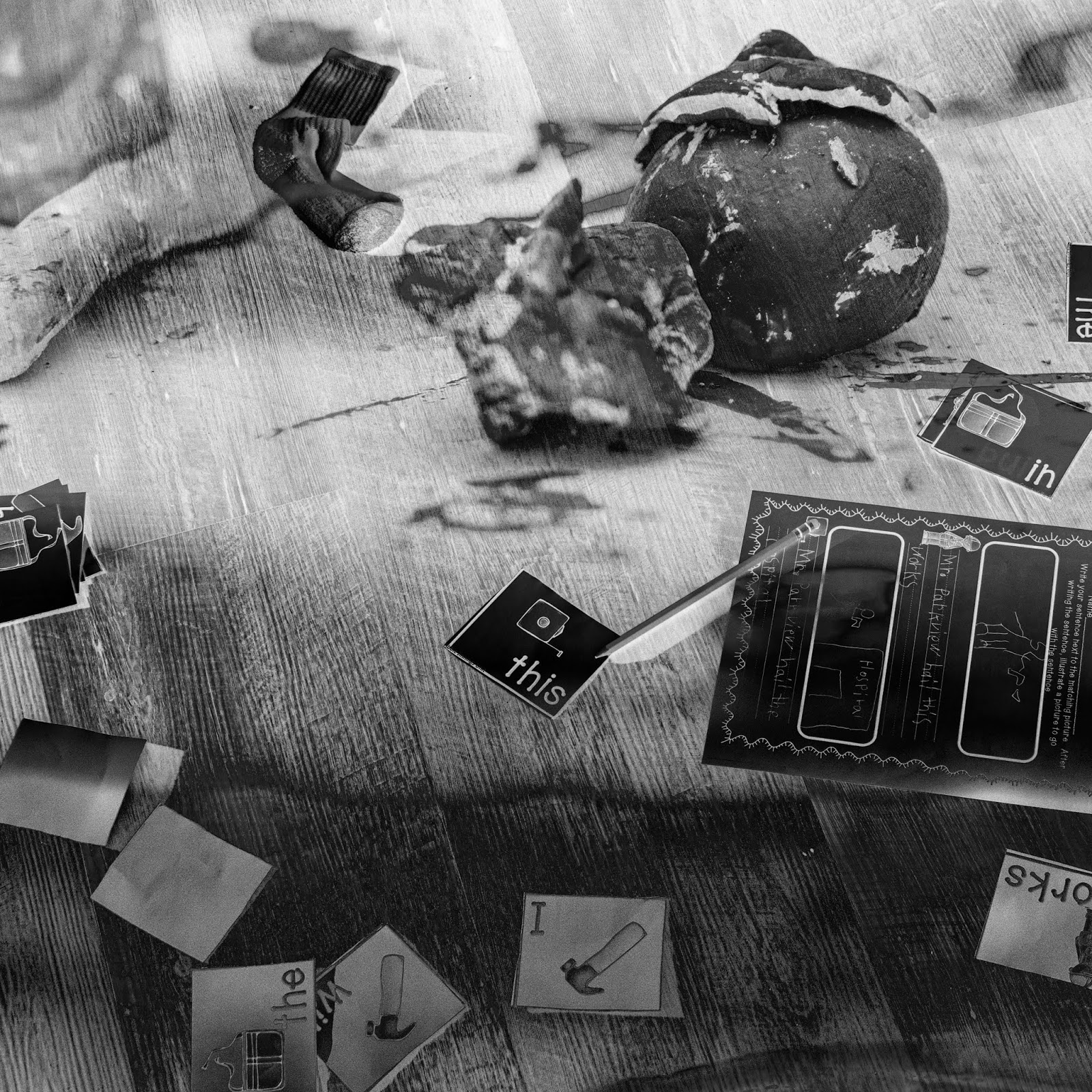
Fig. 3: Slade 2020.


Fig. 4: Slade 2020.


Fig. 5: Slade 2020.


Figure 1. Herbert MATTER. 1990. [light drawing]. V&A [online] Available at: https://library.stanford.edu/collections/herbert-matter-photograph-collection [accessed 18 May 2020].
Figures 2-5. Bren Slade 2020.

LANDES, Jennifer. 2014. 'Herbert Matter's Photographs.' The East Hampton Star. May [online]. Available at: https://www.easthamptonstar.com/archive/herbert-matters-photographs [accessed 18 May 2020].


The Teddy Bear Project Expands

Still 'exploring new threads' and direction for my project, Dr. Wendy McMurdo mentioned the rainbows happening along the same vein as the Teddy Bears being placed in windows.  I decided to expand the project to accept a variety of images that represent how children and people reached to others during isolation.  Here are some fun additions: 

Fig. 1: Submitted to the project by Melissa Hammar


Hidden rocks, painted and dispersed for others to find.  I received images from both painters and finders.  


 Fig. 2: Submitted to the project by Katie Slade


Other positive and encouraging 'window' messages.


Fig. 3: Submitted to the project by Taylor Bingham.


'Hugs' sent by mail to isolated loved ones.  


Fig. 4: Submitted to the project by Nichole Harvey


Combinations of two or more ideas in the same image.


"A kind gesture can reach a wound that only compassion can heal." 
(Marabloi 2009)


MARABLOI, Steve. 2009. Life, the Truth, and Being Free. A Better Today Publishing: Port Washington, New York.

Tuesday, May 12, 2020

Charlotte Cotton

Charlotte Cotton is a curator and writer, with influential work in contextualizing contemporary photography.

Because my images often involve storytelling I am interested on the thoughts of Cotton on the tableau-vivant area of photography.

Tableau photography has a history in pre-photographic era art including the eighteenth and nineteenth century figurative painting.  Today we still share the cultural ability to recognize props and characters and a frozen or 'pregnant' moment of a story being told (Cotton 2014).

I was able to watch the recording of the Living Image Symposium at Falmouth University that happened on March of 2019 with Charlotte herself as she discusses the project; Public, Private, Secret, a work for our era that bring works that discuss how images making and consumption are embedded in a larger scheme of  online behavior and social codes.  

She presents her photo projects like many others that start with a personal curiosity and investment.  She is diverse in form and narrative and also role she takes on but always with a desire to participate.  She has found her place working through curatorialy the issues our collective conscious has to carry- hopefully projecting our prevail.  

It's a new time for technology, and technology is affecting our identity unlike any other time in history.   

Cotton excels at creating spaces and in this project she imagined spaces for people to work out the extent to be both optimistic and skeptical. 

Though looking at her portfolio her work that interests me the most may be her book Photography is Magic.  

Richard Rivera describes it as "a tour de force of all visual media that may stray or touch in the most peripheral way upon any photographic means to create an image" (New Your Journal of Books).  Abstract, conceptual, and digital composites are all interests in my own photography.  And particularly how technology is reshaping photography.
  
Fig. 1: Slade 2020


Figure 1. Bren SLADE. 2020.

COTTON, Charlotte. 2014 The Photograph as Contemporary Art. Third edition. New York, NY: Thames & Hudson.

COTTON, Charlotte. 2015. Photography is Magic. New York, N.Y: Aperture.

Living Image Symposium. 2019. Falmouth University [online] Available at: https://falmouthflexible.instructure.com/courses/249/pages/the-living-image-symposium-charlotte-cotton-march-2019?module_item_id=26307 [accessed 12 May 2020].


Saturday, May 9, 2020

Photomontage

Photomontage 


My new images representing the ever-shifting, fluid world of an isolation house for 7. 

My SOOC photos were ok, but since compositing is really my specialty I decided to try something new with it.  These images are different for me, and unlike any other collection I have done.  So far I am liking where they are going.  

A bit like Tom Epperson's abstract photomontages combining overlooked items of everyday life, in a process of decontruction and construction resulting in seamless graphic abstractions 
(Enriquez 2011). 

Fig. 1: SLADE 2020. 

Fig. 2: SLADE 2020. 


FIG. 3 SLADE 2020. 

Fig. 4: SLADE 2020. 

Fig. 5: SLADE 2020. 

Figures 1-5. Bren SLADE. 2020. Isolation House for Seven. 


Choosing black and white to limit the distraction of color and focus instead on shapes, lines and textures.

ENRIQUEZ, Marge C. 2011. 'Tom Epperson's Abstract Photomontage.' Lifestyle Inc. Available at: https://lifestyle.inquirer.net/27015/tom-epperson’s-abstract-photomontage/ [accessed 9 May].

Tuesday, May 5, 2020

Disappointment

Idaho Family Magazine lost too many sponsors during the quarantine to create a May/June Issue.  So that means my article will not be a part of it.  They are hoping for a July/August issue but nothing is guaranteed.  As my 4 year old niece says, "Stupid CORONAVIRUS."

Image curtesy of EnvatoElements


It's understandable.  This is new territory for all of us.   Nothing to do now but press onward.  

Monday, May 4, 2020

House for Seven

Isolation House for Seven Please
COVID-19 images by Photographer Bren Slade


We are all in each others space.  
Homework on the floor, toys on the computers (toys everywhere).
Spaces created within spaces, 
as everyone navigates a new normal,
 and tries to find their own 'place' in this confined chaos. 


All images ©Bren Slade 2020


New Threads - Traces of Play

I'm still being encouraged to try new things, new lines or 'threads' to see where they will lead.

'Traces of Play'

5 kids in quarantine

"We are at our most curious and adaptable as children, before our worldview becomes rigid with the weight of experience" (Palumbo 2012).


Fig. 1: Slade 2020.


Fig. 2: Slade 2020.


Fig. 3: Slade 2020.


Fig. 4: Slade 2020.

Fig. 5: Slade 2020.


Inspired by photography such as the work of 
Jesse Burke

Fig. 6: Burke 2012.

In his collection Wild and Precious Burke documents the exploration of his daughter, Clover Lee, particularly in nature.  

Instead of exploring a child's complicated relationship with nature I am exploring my children's relationship to their own environment, isolation in close quarters.  What happen's when play is contained in essentially the 'four walls' of the home.  They begin to explore nooks and crannies previously neglected and soon the Traces of Play are everywhere.  

Julie Blackmon is another photographer who's children based work is described as images of "controlled chaos" (Palumbo 2012).

                                                      Fig. 7: Blackmon. New Chair.

When kids rule in every area of the house, Blackmon explores the rituals of family life, like chaos with a conductor- which is Blackmon herself, being her lens. She uses color and theatrical staging in her semi- autobiographical works reflecting domestic life and the often paradoxical expectations of family life (Palumbo 2012).


Figures 1-5. Bren SLADE. 2020. Traces of Play. 
Figure 6. Jesse BURKE. 2012. Wild and Precious [online]. Available at: http://www.wildandprecious.co/about [accessed 4 May 2020].
Figure 7. Julie BLACKMON. New Chair [online]. Available at: https://www.julieblackmon.com/index.cfm [accessed 4 May 2020].

PALUMBO, Jacqui. 2019. '6 Photographers Who Capture Childhood.' Visual Culture. Available at: https://www.artsy.net/article/artsy-editorial-6-photographers-making-powerful-work-childhood [accessed 4 May 2020]. 


Monday, April 20, 2020

Guest Lecture with Jesse Alexander

Working title: Forrest Operations 

Guest Lecture at Falmouth University, April 20th, 2020.
With Jesse Alexander


The Pastoral-Jesse mentioned that in this crisis we are all sort of living a pastoral life now. Often        mythology of the countryside, which is not so much misrepresentation but partial. 

Death- suicide particularly males. 

Elegy- poem or remembrance.


A pastoral elegy, like a poem or a remembrance of mourning, represented in the nature.   

Quotes shared by Jesse Alexander, screenshot by author.


Methodology- shooting a half a roll or so at a time.  Not so rigorous.  Using slide film- which seems natural since it's very indexical of the subject.  Slide is also good for color and it responds to the subtleties of light.  And shooting with a tripod.  The aestheticized territory has both felt risky and liberating for him.  

Interesting that he used the term 'portraits of trees.' But I feel that is accurate after seeing some of the work he shared.  

A fellow student recommended Overstory by Richard Powers as catalyst as a new way to look at trees: 


One last quote shared by Jesse (Screenshot by Author):


Tuesday, April 14, 2020

A Support Group

I began a social media 'group page' on Facebook as a landing page to collect images from people around the world.  Some were already participating and shared their images, some joined the group to start participating themselves.   I have collected hundreds of images from across the US and also many different countries.

But it has become more than that.

Now it runs as more of a positive support group.

Fig. 1: Image donated to the project from Nibley, Utah, USA.  The Teddy Bear Project of COVID-19.

People aren't just posting images,  they are posting commentary, and responding to each others posts and comments. 

Posting bears that supported someone through previous or current cancer treatments, bears from grown children whom they are currently isolated from, bears with a history, family heirlooms, bears from loved ones in the military, handmade bears created to calm nerves, and so on.  A little bit of their human counterpart in each post.  

Here are some 
screenshots of (unsolicited)posts/comments/thoughts:


I thought I would start this project to have an effect on people as they look back on COVID-19 and how we remember the children during this time- I am pleased that it seems to be having an effect on people right now, as we all survive this craziness together.  


Figure 1. Image donated to the project from Nibley, Utah, USA.  The Teddy Bear Project of COVID-19. Available at: www.TBearProject.com

Progress

Exciting happenings! 

Idaho Family Magazine would like to run an editorial with my Teddy Bear Project of COVID-19 in their next issue of their magazine.  


https://idahofamilymagazine.com


Idaho Family Magazine is a family based magazine with around 20,000 printed copies distributed around the Treasure Valley area, and an online audience as well.  

This would be an excellent opportunity for a 'professional output' for this project.  

Previously I had been planning on a face to face show which is, obviously, not going to happen anytime soon.

Looking at my collection of images, which is daily growing, I would love for them to be part of a physical show sometime in the future, but now see them as being part of a larger show illustrating COVID-19 life, or a collaborative illustrating many points of view.  

I also think a book would be a beneficial output, but not until this COVID-19 sufficiently passes, as the collection is still growing and the outcome should be known before a display along those lines.  

Wednesday, April 1, 2020

Photography and Who We Are

"Photography is fundamental to the ways we define and understand who we are" (Heiferman 2012:17). Photography also has naturally crossed boundaries from the beginning, "free of historical limits," (Bate 2016). 

Imagery is a universal language, though translations vary with the diverseness of human existence. 


 Fig. 1: Slade 2020
In 'week 1' of my very first module (Positions and Practice) we were introduced to the analogy that photographs can be a window or a mirror.  Some of the very first photographic images ever created contained windows.  


Fig. 2: Slade 2020
In these images we gaze at the 'bear' or other objects gazing out, even as we, the viewer, 'gaze' in.  Both of us separated by two layers of glass, the pane of the window, and the camera lens itself. Reflections also fill the windows with glimpses of the outside world, creating a hint of the subject's actual gaze, and a secondary path for our gaze as the viewers.   
Fig. 3: Image donated to the project by Jeanette Holmes, Rexburg Idaho, USA. 
The Teddy Bear Project of COVID-19 2020.

Occasionally in the reflection there also contains the camera and photographer behind it- increasing the amount of gazes, as we look at them, looking at the bears, who are looking out at the world, and seemingly at us.  

Roland Barthes observed "The more technology develops the diffusion of information... the more it provides the means of masking the constructed meaning under the appearance of the given image" (Barthes in Heiferman 2012:15)

We are left wondering if the owners view any 'constructed meaning' behind these images of their bears.  And when they look back on the images in the distant future, will they construct the meaning differently than in the moment.  Will they perhaps see themselves, or their loved ones, gazing out from behind the glass?  

BATE, David. 2016. 'Global Photography.' Photography: The Key Concepts in Photography. London; Bloomsbury Academic.


HEIFERMAN, Marvin. 2012. Photography Changes Everything. New York; Washington, D. C.: Aperture.

Reflections

As I look back through this, my MA journey with Falmouth, I am pretty amazed at the experiences I have had and the progress I have made pers...