Saturday, February 16, 2019

New Images Complete

This week I finished up several images that I have been laboring on since Christmas.

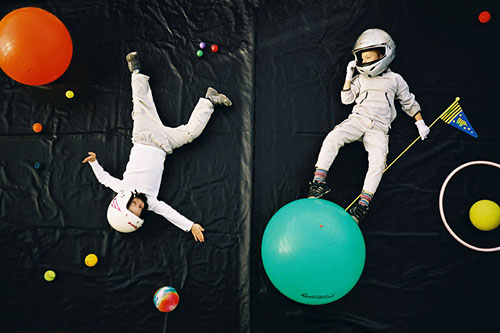
Fig. 1: Slade 2019. Wild Things 2

The first is the series of 3 images with two boys, one Autistic and one struggling on the Fetal Alcohol Spectrum Disorder. Though very different situations, both boys struggle to understand and control their environments.  Their mothers often interact and provide support to one another in their own struggles, therefore the boys are somewhat friends.  These boys are very much like the boy in the story, Where the Wild Things Are, by Maurice Sendak, that I wanted to create the environment they imagine, where they are in control.

You can see all three images here: www.brenslade.com


I also finished the images for this family of 4 sisters (which you can view at the same link):

Fig. 2: Slade 2019. Four Sisters

Their entire existence is beautiful and fragile, off balance and delicate.  Yet full of hope and joy.


Thanks to the recent webinars I have some new ideas going forward but wanted to finish these images out.

Figure 1: Bren SLADE. 2019. Wild Things 2V&A [online]Available at: www.brenslade.com

Figure 2: Bren SLADE. 2019. Four Sisters. V&A [online]Available at: www.brenslade.com
Sendak, M. 2000. Where the Wild Things Are, Red Fox, London.

The Viewing of 2 Artistic Events

This week I had the opportunity to attend two unique and different artistic events.  The first was the opening and artist reception for 'Habitat and Refuge' by photographer Darren Clark, at the Jacob Spori Art Gallery.
Fig. 1: Slade. 2019 A quick screenshot at the Entrance


It was a unique collection with some very appealing images.  Darren Clark is an "avid birder and landscape photographer," (Dabell, 2019 at http://www.byui.edu/spori-gallery/current-exhibit) specializing in the forgotten and unique habitats for specialized birds.  I particularly enjoyed his portraits and captures of individual birds and the stories they had to tell.

On his online gallery I also enjoyed his images investigating agriculture and the relationship between the natural and cultural geography.

Fig. 2: Clark 2002. Grain Elevator, Hansen ID Photograph                       

I actually enjoyed the online gallery a bit more than the actual exhibit.  His gallery images displayed at the Spori Gallery were matted and framed in a bit of an antiquated way that I didn't resonate with and I thought the images may have been more effectively displayed without glass and reaching from frame edge to frame edge.  That may have just been my personal opinion.  

The show seemed a very traditional way to consume art and gave me some future reference for how I might want my own show displayed and consumed.  

The second event I attended was a performance of the Golden Dragon Acrobats.  Though not photography, I was extremely affected by the artistic feel and rhythm through out the performance and would definitely categorize it as visual art. 


                                                Golden Dragon Acrobats accessed from Yahoo Images, 2019

The entire show was very visually engaging.  The use of light, color, shape, the icon and the index to create a Tableau was all there- just as in photography. This study of photography has opened my eyes to world of constructed beauty and images around me, in many interdisciplinary formats and displays. 

Everything I view becomes part of who I am. And who I am is reflected in the images I produce as a photographer, also affecting my connect-ability with the viewers of my work.  


Figure 1: Slade. 2019 A quick screenshot at the Entrance
Figure 2: Clark 2002. Grain Elevator, Hansen ID. V&A [online] Available at:http://www.darrenclarkphoto.com/eastern-idaho-architecture.html
http://www.byui.edu/spori-gallery/current-exhibit
https://www.goldendragonacrobats.com/

Wednesday, February 13, 2019

On Mary Ellen Mark

Fig. 1: Mark 1992. Clayton Moore, The Former Lone Ranger, Los Angeles [photograph]

Even though my images are composites and usually contain a full scene, I still think of them somewhat as portraiture.  It is all about representing the subject.  My images focus on children, and the images have a lot going on in them, since children have a lot going on in their heads.

In the last webinar Mary Ellen Mark was recommended.  I was able to locate some great portraiture advice published by her, posthumously.

The first advice is to try to shoot images that follow the grain of the subjects personality.  "It's not a good idea to try to ask people to behave in ways that don't seem natural for them" (Mark 2015). The picture is not all about you as a photographer, but about the person themselves.  I strive for this in my work as well.  Since I want my image to be representative of the child's life there is a disconnect if I don't get to know the child and the family in a personal way.  I think some of my images that don't work for me typically have to do with my own constructed ideas about the child, but a gap in what actually is the child.

The other element I appreciated was that she strives for her images to go beyond her story. She strives for every image to be epic, though she realizes that may not be possible.  I like her tenacity there.

In the end she recommends not letting the great legacy of history's photographers paralyze you.  She encourages all to contribute to the legacy and be your own person.   She says not to stress over making your style different, that will come from shooting from your own point of view (Mark 2015).

Mary Ellen Mark represented the distinctive but commonplace (Oxford University Press 2018).  I love the contradictory idea there.  I feel the children I work with are the same, distinctive and commonplace, unique but not alone.  Mary Ellen Mark also looked for human elements that connect to all of us.


Figure 1: Mary Ellen MARK 1992 From: Mary Ellen Mark 2015 On Portraiture and the MomentPhoto District News. Vol. 35 Issue 9, p42-44. 3p. 

Mark, M.E.  (1940–2015) 2018, , 2nd edn, Oxford University Press.


Tuesday, February 12, 2019

Sometimes We Want Construction, Sometimes We Want the Real

As this weeks presentations began I immediately thought of Jeff Wall and and Charlotte Cotton before they were even mentioned (this was a new experience for me since I had heard of neither before starting this program).

I also thought of John Wilhelm.  Born in 1970 in Switzerland, he essentially grew up with photography.  In 2011 he began to explore photoshop and 3D tools and now he says photography is "a complete passion."

Fig. 1: Wilhelm. Children Have No Choice [photograph]


John would be considered as 'Farmer' and constructs his images digitally with photoshop and other 3D tools.  

Looking at other mediums- Edward Degas and his famous dancer images.  Though the art medium would lend him to be a farmer also, he may have hunted the scenes in real life before producing.

Fig. 2: Degas. The Dance Class II 

Then there is the Australian photographer Peter Lik who hunts his opportunities for 'pristine images' compared in the Washington post to the avid Crocodile Hunter (McCoy & Kirkpatrick, 2014) 

Fig. 3 Lik. Whispering Sea [photograph] https://lik.com/collections/new-release/products/whispering-sea

This weeks videos and reading synched completely with the progress of my project.  After last weeks webinar and the suggestions and reflections I received I have recognized that although I will continue to construct, I will take a closer look and be careful not to dismiss the real.

I'm carefully hunting a few 'real' images I will consider adding into my project along side their more 'constructed' counterparts.

I definitely assert my images as pure fiction.  I still strive for believe-ablity and to create that sense of connection- I want people to complete or even construct the narrative of my image for themselves.

In My Practice: I need to work on inviting the narrative, not telling so much as asking.

"I photograph to find out what something will look like photographed" (Winogrand, cited in Badger 1885)
I photograph to see what the imagination looks like, in a photograph.  Like Soth, "I take the reality of the world and use it as a springboard for the imagination," (Soth, cited in Bubich 2015). Only in the actual construction of the image as well.


Figure 1: John WILHELM. Children Have No Choice. [photograph] V&A [online]. Available at: https://www.johnwilhelm.ch/bestof?lightbox=dataItem-itkjkdec

Figure 2: Edgar DEGAS. The Dance Class II. V&A [online] Avalable at: https://www.edgar-degas.org/The-Dance-Class-II.ht

Figure 3: Peter LIK. Whispering Sea [photograph]. V&A [online] Available at https://lik.com/collections/new-release/products/whispering-sea

Bubich, Olga (2015) 'Alec Soth: photography is a unique medium with its own mix of variables' in Bleek Magazine (7th September 2015) www.https://goo.gl/SF0e9h
https://www.johnwilhelm.ch/making-of

  • McCoy, T. & Kirkpatrick, N. 2014, This Peter Lik photograph reportedly just went for a world record $6.5 million, WP Company LLC d/b/a The Washington Post, Washington.
  • https://lik.com/collections/new-release/products/whispering-sea

Thursday, February 7, 2019

The Real And The Iconic

As Szarkowski points out; photography deals with the actual.  But it is also just an image of the actual- not the actual themselves (Szarkowski, 1966).  My photographs often contain barely a trace of the actual.  To the obvious extreme, but past the point of deception, and instead to spark the fantastical.

In C.S. Peirce's semiotic theory the index is based on the image reflecting actual representation. 
Lets look at this simple image representing some natural produce of the midwest:

Fig. 1: Slade 2018.

In this image the Icon would be- a squash, or a squash family.
The Index of the squash may be food we eat.  Or food we are able to grow.
The Symbol is a little more interpretive and may be the struggle of being different, or fitting in with a crowd.

C.S. Peirce may not of enjoyed my style of images, or regarded them in the family of photography at all.  Many current photographers, ones who strive for the indexicality of the image, may agree.  Yet the trace is there, even if the manipulation is more obvious.

My images are not unique in their genre.  Similar to my work are the dream like tableaux of Martina Lopez, who, when introduced to computer editing over a decade ago immediately recognized its potential (Hess).
Fig. 2: Lopez 1994. Revelations in Time 1 [cibachrome print]

In photography, is 'automatism' (Cavell, 1971) a must for an image to be considered true photography or does a 'trace' of the actual qualify? If the first is true then I am not sure my images are photography at all. But if the second is acceptable them my images are photography in what is becoming its new form, in a most illustrative example.  The process is there from 'birth' (Arnheim, 1974), and even though it is manipulated in post, its origins in photography still make a difference, even though my images are edited.

For example here are some images from a recent project session:

This is Jane*.
                                                              Fig. 3: Slade 2018.

Jane has Microcephaly among other diagnosis.  She is 100% care dependent.  She is non-mobil and non-verbal, and she has to be fed by a G-tube. She has surprised doctors by bypassing her estimated life span.  Jane has 3 sisters, 2 of which were born with Cystic Fibrosis. Their family lives an alternate form of 'normal' life.  Here are the 4 girls together:

Fig. 4: Slade 2019. Four Sisters

Only a family that cares for a severely disabled child can understand the extreme difficulties, countered with the extreme joy that child brings into the home.  The whole family cares for Jane in uttermost unselfish and tender ways.  You only have to watch their interactions to see the joy and love that she returns to each one- similar to the joys of a newborn babe.  I myself have heard her giggle.

Here are some SOOC images of Jane that I captured:


Here is the image I completed for the mother:
 Fig. 5: Slade 2019. Child Alive
The Icon is still a child.
The Index may still be that of disability, as exhibited particularly in the hands and feet. 
But the Symbol becomes life and beauty.

In this image, particularly when you look at the eyes, my goal was for the 'trace' of the 'real' to be a trace of her beautiful SOUL.

Her mother's reaction to the image:

"I'm seriously crying right now. This is the single greatest gift anyone could ever give me. You are insanely talented.This girl is life!" 

The mother complimented my talent- but only because I illustrated Jane in the way she already sees her everyday.

What truth does photography offer us?  I believe the truth it offers is the proof of Human Connection.  The photographic image crosses all cultures and knows no human diversity.  Each human may connect individually, and in vastly differing ways.  But the connection is there nonetheless, evidence of some universal human binding agent.


UPDATE:
 This weeks webinar was particularly interested and I presented my images of Jane for discussion.  A great discussion ensued that covered everything from why I represented her the way I did, and the value of some of the SOOC photos- particularly the power in this one:

                                                                Fig. 6: Slade 2018.
The combination of her eye contact, and the caregivers hand on edge speaks volumes in this image.  It made me interested to look back through my other images to view the SOOC images in a new light.  And perhaps include them in my project in juxtaposition with the edited ones (there was a suggestion that the raw may be more powerful than the edited one but the conclusion was it is the edited one that sparks the conversation about the raw).

I also got some wonderful suggestions for future resources to visit or revisit- I will note them below:


The Documentary Impulse 
by Stuart Franklin

Mary Ellen Mark @
http://www.maryellenmark.com/books/titles/ward_81/index001_ward81.html
also 'Ward 81' hardcover
Leon Borensztein
https://www.leonborensztein.com/sharon
Wendy Ewald
http://wendyewald.com/portfolio/margate-towards-a-promised-land/
Clementine Schneidermann
https://www.clementineschneider.com/publications-1/
Another Way of Telling by John Beger
Jo Sutherst
Photography Degree Zero; Reflections on Roland Barthes' Camera Lucida
The Photography Reader by Liz Wells
The Documentary Impulse By Stuart Franklin


Figure 1: Bren SLADE. 2019. Private Collection: Bren Slade.

Figure. 2: Marrina LOPEZ 1994. Revelations in Time 1 [cibachrome print]

Figure 3-6: Bren SLADE. 2018-2019. Private Collection: Bren Slade.

ARNHEIM, Rudolf. 1974. On the Nature of Photography, Critical Inquiry

CAVELL, Stanley 1971. The World Viewed, New York

HESSE, Gary. Digital Allegory Martina Lopez. V&A 2019 [online] Available at: http://www.johnvalentino.com/Teaching/Art190/Projects/190Proj3/Lopez/MartinaLopez.html)

PEIRCE, C.S. 1986. Philosophical Writings of Peirce, Dover Publications;New York. Available from: ProQuest Ebook Central.

SZARKOWSKI, John 1966 The Photographers Eye, New York: Museum of Modern Art

*The children featured here in this project are real, their names are not. 

Wednesday, January 30, 2019

A Name Change

SiennaCG2Warm.jpg
Fig. 1: Alsop [photography]


It's come to my attention that Karen Also has an ongoing collection of images of children with special needs call 'The Heart' Project.  Her project differs than mine in its intent create images of kids moving beyond their disabilities.  However because our composite style is similar and to avoid confusion I am going to take 'Heart' out of my project name and change it to

'Healing Hope Images' 

Karen did not contact me - But I hope to work collaboratively with her in the future so I thought it
best if our project names were different. 

Figure. 1: Karen ALSOP [photography]. V&A 2019 [online] https://heartproject.smugmug.com/

Informing Contexts Week 1- Context Shapeshifting

As Szarkowski claims photography is a process not based on synthesis but selection (Szarkowski, 1966).  As photographers we are doing the selecting.  Where we place the camera, the light we choose, how tight we crop, it all makes a selection with in our control.

Szarkowski lists 5 Characteristics:
The Think Itself
The Detail
The Frame
Time
The Vantage Point
(Szarkowski, 1966)

One characteristic I might add is 'Light.'
http://lemarbarrett.blogspot.com/2014/05/research-and-planning-this-essay-will.html

Light is paramount in photography to the point it almost has meaning in itself.  Where the light is coming from, what it illuminates or what it conceals has great effects both presentation and interpretation of the images.  Shore also defines 4 central ways a photograph is transformed; flatness, frame time and focus (Shore, 1998), - but again Light is left unrecognized.  Perhaps its because I work with composites that I recognize light to be such a living element of photography.  In composites one is continually seeking the light, the source and the amount to better understand the relationship of the elements within the image.


The only characteristic I might reject is 'the thing itself.'  There is too much manipulation in photography to holistically accept what is pictured as the actual, or the actual in fragments. Even if there is no post editing the other characteristics listed (detail, frame, time, vantage point) all manipulate the actual that we are viewing.

The inside of a guitar, Sourced @https://www.elitereaders.com/50-stunning-photos-arent-seem/?cn-reloaded=1


Maybe what I reject is that a photograph can represent with the intent of one specific actual interpretation.  Because even without the photographers manipulation of presentation the viewer themselves interpret according to their own knowledge base in a number of variety of ways single to each viewer.  If photography is capturing or revealing a real thing why does it fulfill in us such a sense of creation?
At the same time- if photography isn't a tangible sense of reality then what comes closer?  Maybe nothing.

In the construction of the Tableau in photography I believe today we are doing nothing different than has been done for years in photography.  We just have a variety of more accessible tools to do it with.  In my photography I take the 'made' object to the extreme, to a whole other world, but the gap is so conscientiously wide the viewer is obviously aware.

The characteristic top of the importance list in my photography is 'Time'.  Particularly because I photograph children. As a mother of 5 children I am a witness to the unavoidable element of time passing.  And capturing a moment in time before it is gone has great nostalgic meaning and value to a parent that has much investment in an end product, but true love for the moments that have passed.

I am interested in Shore's description of Extrusive Time- with a longer exposure and a thinner veil between reality and dreams (Shore, 1998).  I may want to incorporate this into a future image.


John SZARKOWSKIS. 1966. The Photographer's Eye. New York: Museum of Modern Art.
http://lemarbarrett.blogspot.com/2014/05/research-and-planning-this-essay-will.html
https://www.elitereaders.com/50-stunning-photos-arent-seem/?cn-reloaded=1


Monday, January 14, 2019

Exciting Update

 http://www.healingimages.org/about

Just got a phone call from Monique Boucher at HealingImages.org to let me know that a hospital in Brazil is considering choosing some of my images for their children's wing!  How exciting.  Fingers crossed! I have also been added as an official member of their 'Photographic Family.'

The Tables Turn


Figure1: ArtisticOpperations. 2018

Two unsettling events happened over the break, which was unfortunate for our family, but delivered new perspective on the purpose of my current project.  Since everything was well in the end, I feel the most productive thing to do now is reflect on our experience in evaluation of the goals I'm hoping to accomplish with my photography art. 

Just before Christmas my young daughter broke her arm in a sledding accident on a small neighborhood sledding hill.  It was past office hours so we rushed her to the local urgent care.  After checking us in they escorted us to x-ray.  My daughter, who I mentioned is quite young, did not appreciate them moving her arm about in order to xray and was hurting and crying.  I looked around for something to distract her and noticed the x-ray room walls contained images of cartoon characters.  I started pointing them out to her and immediately she quit crying while she looked around at each image.  Then they moved us to our examining room where the walls were bare.  With nothing else to look at she resumed her discouraged attitude.

Since the break in her arm was right at the elbow, we went to surgery a few days later so the doctors could straighten her arm and place some pins to help it heal correctly.  Once checked into the hospital, for a while we all waited together with her ready to go, in a hospital bed in a small partitioned room, that reminded me of an office cubicle.  Again, bare walls and nothing to look at while waiting.  After the surgery we were placed in a similar 'room' for recovery.

All was well and she seemed to recover quickly, not even asking for pain medication after the second day.  Christmas eve we woke all the kids to begin the festivities and she awoke but refused to move from her bed.  My husband helped her out and brought her to me, in which I noticed she was walking crooked and swayed as she stood.  She seemed dazed and couldn't answer questions, and after a few jumbled words, couldn't seem to talk at all.  My mother, whom we were visiting, is a retired nurse and took one look at her extremely dilated eyes and recommended a 911 call (emergency in the US).  Her fear was for a post-surgery blood clot.  Luckily there was an ER nearby.  It took about 45 minutes  before my daughter started to come back to her normal self and the doctors ran many tests.  Happy she seemed ok we now waited in a similar 'cubicle' partitioned room for the results.  Nothing is fast when it comes to medical things so we had plenty of time to stare at the walls.  There was a television in the corner but that just led to a lot of channel flipping looking for something kid appropriate. Even though the tests were inconclusive our daughter recovered fully and hasn't had any follow up episodes.  I began to reflect on this experience in relationship to my project and the planned output of donating the finished art pieces to the not-for-profit organizations.

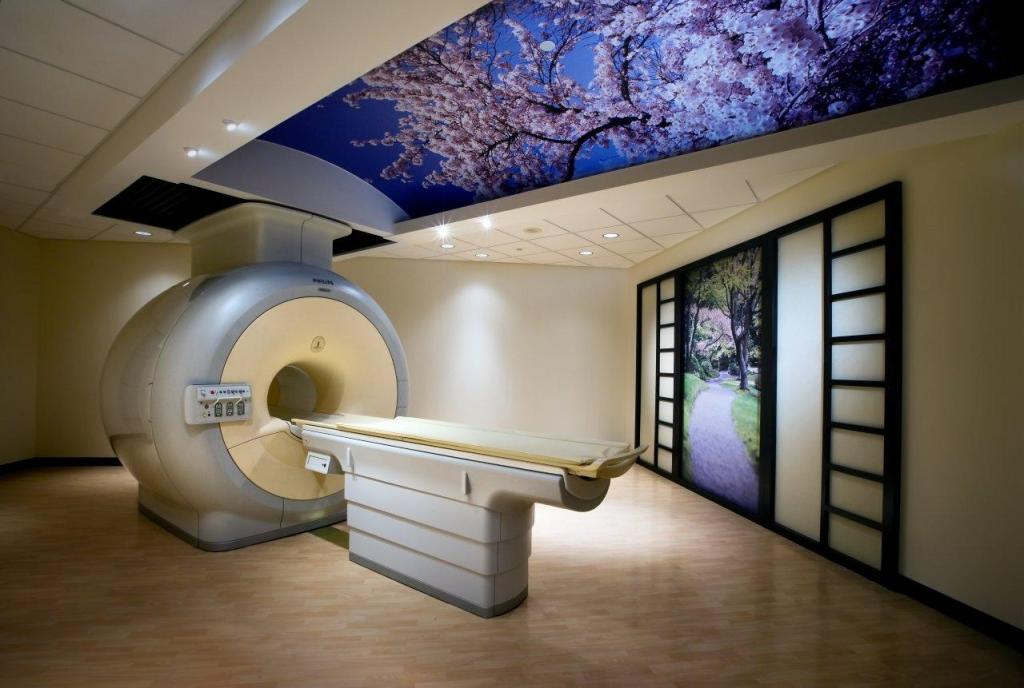
Can the presence of fine art on the walls make a difference in the atmosphere and experience of anxiety-filled situations?  I believe I discovered first hand that it could.  Where we currently live we are lucky that our medical facilities do already value art in many areas of their buildings, including waiting rooms and hallways.  But I learned those small and bare partitioned rooms are where some of the highest anxiety filled moments exist.  But they are so small already I could see how issues might arise with hanging items standing out from the walls, possibly making them fill more enclosed.

In talking with a friend who has multiple chronically ill children we discussed the experience and the idea of art in the small rooms.  She heartily agreed that there would be benefit there and mentioned that she had heard of MRI 'suites' being designed with large and illuminated artwork on the ceiling.
BC_HC_080328_0006_S
 Figure 2. Barton Associates (2019)

I loved the idea but contemplated the cost of such a luxury probably far above something hospitals could spare for each small partitioned room.  But I did LOVE the idea of art on the ceiling and am experimenting with 24x24 metal prints that can be exchanged out for ceiling tiles.


Figure1: ArtisticOpperations. 2018. V&A 2019 [online] Available at: www.pixabay.com
Figure 2. Barton Associates. 2019. V&A 2019 [online] Available at: https://www.ba-inc.com/

Friday, January 4, 2019

Reflections and Intent

'Without some kind of intellectual mechanism, then you get this terrible, terrible thing that is just meaningless transcription'
(Hodgson 2012)

               Fig. 1: Kessels 2001. 24 Hours in Photographs [photograph]                                   

Kessels' image above brings out a lot of questions about my own current practice.  Metaphorically every photographer's works are in this sea of images.  What is the purpose of mine?  What role will they play.  Who will find them important, entertaining, delightful, disruptive?  And how selective am I about what I put out into the world?

My Intent:
As a photographer of over 20 years, much of my learning has been self initiated.  My undergraduate was in Elementary Education, with certifications in Library Media and ESL.   Working with, and mentoring children is a passion of mine.  I eventually shifted gears out of the public workplace to be passionate about raising my own five children.  I'm not sure if I would say photography is a passion for me, I believe my true passion is capturing and cultivating beauty, freezing time and exploring wonder, and photography is simply the means to that end.  Thus, secondhand-idly photography may be a great passion after all.

I started this MA program to fill the holes I feel exist in my current self-directed practice.  But it has opened more doors to critically thinking about photography itself and my intent thereof is to follow through those opened doors to wherever they may lead.

Human Choices and My Practice: 
My photography is edited.  I use software, stock and graphically designed objects.  If photography is capturing a reality with a lens, my photography aims to capture the world beyond the rules of reality.  The world inside the mind- specifically the imaginative minds children possess.

Fig. 2: Slade 2017. [photograph]                                                            

I have often found it amazing how freely children step into and out of the world of imagination, and how readily children want to accept a world with no limits.

Fig. 3: Slade 2018.  [photograph]                                                            

I choose to work in an illustrative, almost over processed format.  Allowing my painterly look combined with extreme dodging and burning to take the photo itself away from its realistic counterparts, symbolic of the step away from reality they represent.

Fig. 4: Slade 2017. [photograph]                                                    

I also lean toward a lot of detail.  I love my images to have stories with-in stories, as my audience is partially the children themselves I cater to short attention spans, lots of color and movement.  These are some of the 'human choices' that I feel define my images.

Fig. 5: Slade 2017. [photograph]
However it can be a careful balance and sometimes my images have too many details, busy to the point that the subjects blend with the background and your eyes wander without direction or focus. But it all depends on objective.

Fig. 6: Slade 2017. [photograph]                                          
In viewing the Falmouth class video, "Modernism, Postmodernism and Back Again," I recognized that I often connect and view my work from the angle of Artist even thought photography is my medium.  I wondered why I often find myself breaking the 'rules' of photography in ways that seem to work for me and after hearing Ken Rockwell's explanation of artist vs. photographer in reference to Andreas Gursky's Rhine II, I quickly connected it to my own work (Rockwell and Zang, 2011).

Breaking the rules can make us more conscious in the act of looking, and create interest and introspection. However I have broken rules before that did not end up well; for instance in this unicorn image below the light is coming from two different directions and makes the girl appear disconnected from the background.  I realize the rules of photography can be altered, where as the rules of reality (even in a image of non-reality) must continue to exist.
                                                               Fig. 8: Slade 2017. [photograph]                                            

Here you can see the difference when the light blends correctly:
                                                                                                  Fig. 9: Slade 2017. [photograph]          


My Project: 

Currently my MA project revolves around creating through the medium of composite photography a collection of surrealistic, vibrant images of optimism, joy and beauty in representation of the resilient nature of childhood; specifically focusing on children facing complicated and often anxiety filled life situations; including illness, disability, genetic disorders, and any other serious oppositions children find themselves facing.

With the additional aim to donate the created images to healthcare and other facilities to promote hope and an atmosphere of healing to children and adults in difficult circumstances. With the purpose of mental and physical health benefits for those who view them in a hospital or other setting, typically in current situations of anxiety.

In Context:

Capturing childhood is not new to photography.
  
                                              Fig. 10: Photographer Unknown. [photograph]

Childhood in the early 1930’s, Slade Private Collection 2018. 
This is my husband’s grandfather and one of my all time favorite 
representations of childhood. Photographer unknown. 


"Historically, artistic portrayals of children and childhood have gone through many transformations, reflected in the produced imagery of childhood itself. The mythologies range from picturing ‘childhood’ as cherubs in joyous moments of idealism, to a less prejudiced view of children and their experiences as demanded by advent-garde voices starting in the 1970’s (Holland, 2004). "

As well as capturing opposition in childhood.  For example, the collection of images in Stephen Shames 'Outside The Dream: Child Poverty in America' in which Charles Hagen of the New York times comments,

"The greatest strength of "Outside the Dream" is its bracing tone of moral outrage at the effects that poverty can have on children.  In trying to promote social change by arousing public opinion, Mr. Shames follows in the honored documentary tradition of Jacob Riis and Lewis Hine."


The mentioned Jacob Riis and Lewis Hine are two other classic examples of creating images of childhood opposition.
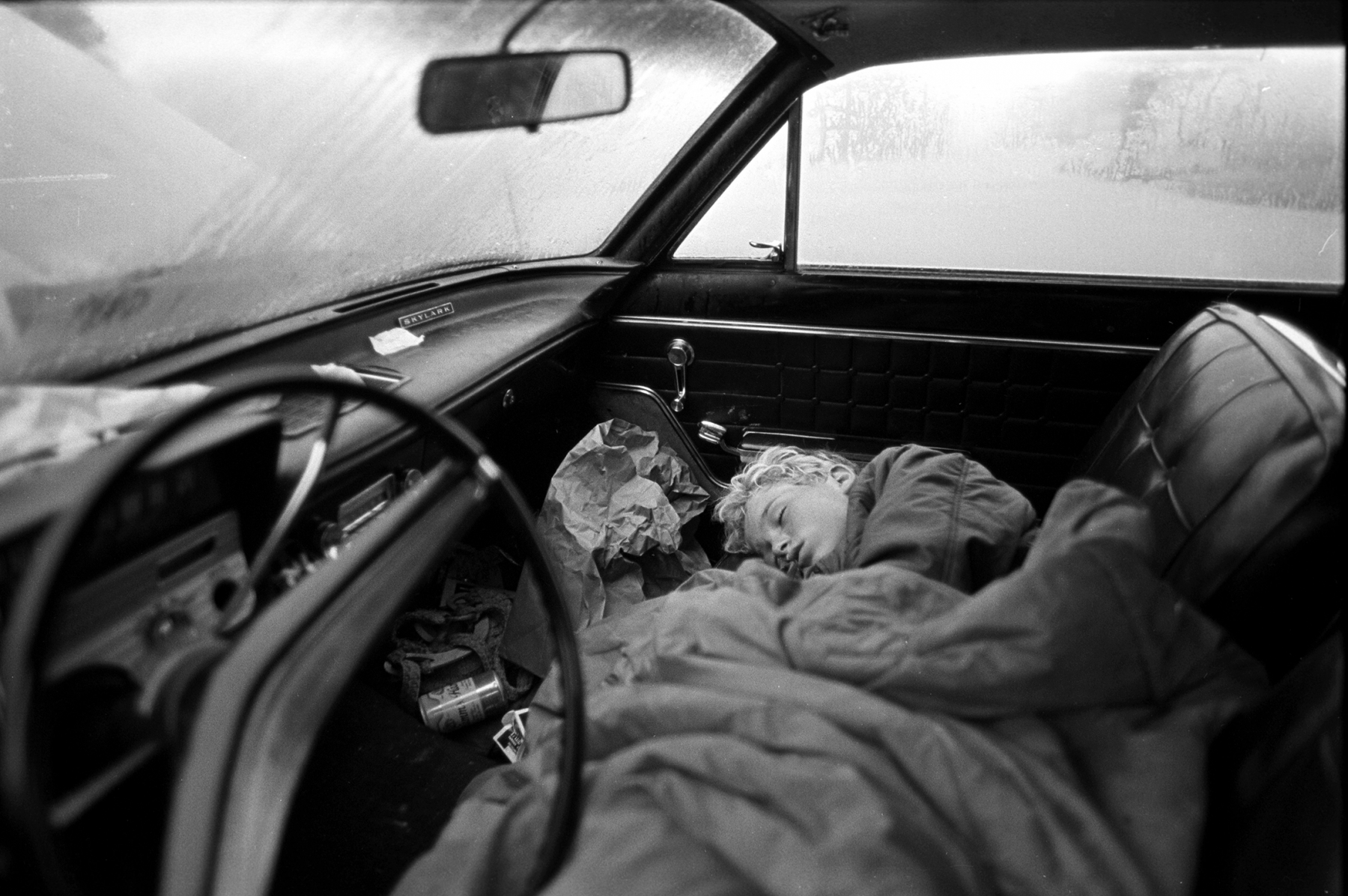
Fig. 11: Shames, Asleep in Car                                                     


But there is variety in representation as well. For example Wendy McMurdo represents childhood by exploring the effects of technology in young education.  She tells Katrina Sluis that her earlier work asked or posed questions about the "way in which traditional play differs from play involving computational objects." (Sluis, 2018).

 Fig. 12: McMurdo 2016. Young Girl                                                      


My Plans:
Unlike many childhood photographers I hope to represent opposition in childhood through the vision of resiliency these children often maintain throughout their difficult circumstances.  

Instead of the lovely but somber and dreary images, like represented by the very talented Lorretta Lux;
Fig. 13: Lux 2001. Hidden Rooms 2                                                        

I hope to bring out play, hope and joy perhaps like the lighter and more playful Jan von Holleben who describes himself as a photographer author and prefers the term 'visual communicator' instead of illustrator.


jvh8
Fig. 14:Von Holleben. Dreams of Flying                                                 


Recently I have been introduced to the paintings of Marc Chagall and I absolutely love his organized chaos of color and his complicated imaginative spaces.  I hope to add him to my studies this semester. 

Fig. 15: Chagall, 1912, The Fiddler

Throughout this course I hope to fine tune my editing process and develop a clearer conceptual base for my images that may open up the context of my images to allow them to be more contemplative in regards to the viewer vs. the story of the child in the image.  

I hope to more carefully tie the visual information together to further demonstrate resilience but in ways that avoid the overdone and cliche' also by individualizing my characters.  

I am partnering with a couple not-for-profit organizations that follow the movement of getting art in hospitals and since my contextual outlet will be in medical facilities I also hope to study more about the medicinal properties of art itself, including the psychology of architecture and design, healing properties of color, art as therapy, and healing environments, and look forward to incorporating that knowledge into my pieces.   

You can see my current project images here: www.BrenSlade.com

Figure. 1: Kessels. 2001. 24 Hours in Photographs [photograph] 
Figure 2-9: Bren SLADE. 2017-2019. Private Collection: Bren Slade.
Figure 10: Unknown. Private Collection: Bren Slade
Figure 11: Stephen SHAMES, Asleep in Car. [photograph] V&A 2019 [online]. Available at: https://stephenshames.com/projects/outside-the-dream-child-poverty-in-america/
Figure 12: Wendy MCMURDO. 2016. Young Girl 
Fig. 13: Lux 2001. Hidden Rooms 2. V&A 2019 [online]. Available at: http://lorettalux.de/selected-works/
Fig 14:  Jan VON HOLLENBEN, Dreams of Flying. V&A 2019 [online]. Available at: https://petapixel.com/2009/08/06/interview-with-jan-von-holleben/
Figure 15: Marc CHAGALL, 1912, The Fiddler
Hagen, C. 1993, Review/Photography; Poverty Among America's Children: Review, Late (East Coast) edn, New York Times Company, New York, N.Y.
Hodgson, F. 2012 Quality Matters at Fotoboekenmarathon (16th December 2012) 
www.fotoboekenmarathon2012-Francis Hodgson

(Links to an external site.)
Links to an external site.
Holland, P. (2004) Picturing Childhood; the myth of the child in popular imagery. London: Tauris 
https://www.huffingtonpost.com/2011/11/14/erik-kessels-photographer_n_1092989.html

Kelly, T. 2011,  Erik Kessels, Photographer, Prints Out 24 Hours Worth Of Flickr Photos, 
Huffington Post.
'Young Girl IV 2016. by Wendy McMurdo; VIEWFINDER', Daily Telegraph (London, England),2017, pp. 3. 
Sluis, K. 2018, Interview with Wendy McMurdo, Unthinking Photography
https://unthinking.photography/articles/interview-with-wendy-mcmurdo
Zhang, M. 2009. Interview with Jan Von Hollenben, PetaPixel
https://petapixel.com/2009/08/06/interview-with-jan-von-holleben/
Zhang, M. 2011. Why Gursky's Photograph of the Rhine is the World's most Expensive Photograph in PetaPixel
 http://petapixel.com/2011/11/14/why-gurskys-photo-of-the-rhine-is-the-worlds-most-expensive-photo/ (Links to an external site.)Links to an external site.


Tuesday, December 18, 2018

A Special Photography Session


Figure 1: Slade 2019. 4 Sisters SOOC image (added post shoot)

I have a very special photography opportunity coming up this Saturday.  Although I feel like with the nature of this project I could start out every post about future photo sessions that way- these children I have the opportunity to work with are more than amazing.

This Saturday I get to create some images with FOUR sisters.  Three of the sisters have Cystic Fibrosis.  Three.  Two of them have G-tubes and one also has additional disabilities and medical conditions.  They are an amazing family.

It's been awesome to get to know them and we have some fun ideas coming together.

I want to try a few new things with this shoot- particularly with lighting and portraiture.  I decided to study up on Ben Shirk because even though he is an award winner and most known for his athletic images (Targeted News Service, 2018) he has some amazing skills when it comes to portraiture and I like his style.

Click here to see an example of Ben's portraits:

Professional Photographers of America Announces Ben Shirk as Winner of Grand Imaging Award 2018, Targeted News Service, Washington, D.C.
Figure 1: Slade 2019. 4 Sisters SOOC image (added post shoot)

Reflections

As I look back through this, my MA journey with Falmouth, I am pretty amazed at the experiences I have had and the progress I have made pers...